Retained method source
Censoring
A pending age is an observed interval
A pending record runs from its notice date to its explicit observed-through date. That endpoint marks the end of the supplied observation. Approval intervals, resolved durations and pending ages are reported separately. A descriptive median for the displayed approval or resolution records is not a censoring-adjusted estimate of a population’s time to that event. NIST explains censoring using reliability examples, including different observation times. The Lifecycle applies that distinction to recorded matter dates and does not fit a survival model or predict an outcome. Its reviewed opening collection ends at signed approval orders; the underlying records distinguish those dates from future funding and distributions.
The description above explains this tool’s implementation. The publisher’s complete retained reading follows.
Source identity and integrity
Complete Censoring article, including Type I and Type II censoring, interval/readout data and original diagram, multicensored data, methods discussion, and the final separating-out-failure-modes qualification.
Retained original · 8,707 bytes862bc2b6d65ffac66dab79f4ce6f4a3973fcab206d98b77e8e63917c950ead2b
Reading copy · 3,692 bytesd582f6b6eb70f76c29283fa144e10327f146bd4429c7454b51bcb9e69acf277f
Full retained text
Text mechanically extracted from the retained publisher source. Use the original or publisher page to inspect mathematical typesetting and layout.
8.1.3.1. Censoring

8.
Assessing Product Reliability

8.1.
Introduction

8.1.3.
What are some common difficulties with reliability data
and how are they overcome?

8.1.3.1.

Censoring

When not all units on test fail we have censored data

Consider a situation in which
we are reliability testing \(n\)

(non-repairable) units taken randomly
from a population. We are investigating the population to determine if
its failure rate is acceptable. In the typical test scenario, we have a
fixed time \(T\) to run the units to see if they survive or fail. The data
obtained are called Censored Type I data.

Censored Type I Data

During the \(T\) hours of test we observe \(r\)

failures (where \(r\)

can be any number from 0 to \(n\)).

The (exact) failure times are \(t_1, \, t_2, \, \ldots, \, t_r\),

and there are \((n - r)\)

units that survived the entire \(T\)-hour test without failing. Note
that \(T\) is fixed in advance and \(r\)

is random, since we don't know
how many failures will occur until the test is run. Note also that we assume
the exact times of failure are recorded when there are failures.

This type of censoring is also called "right censored" data since the
times of failure to the right (i.e., larger than \(T\)) are missing.

Another (much less common) way to test is to decide in advance that you want
to see exactly \(r\)

failure times and then test until they occur. For
example, you might put 100 units on test and decide you want to see at
least half of them fail. Then \(r = 50\),

but \(T\) is unknown until the
50th failure occurs. This is called Censored Type II data.

Censored Type II Data

We observe \(t_1, \, t_2, \, \ldots, \, t_r\),

where \(r\)

is specified in advance. The test ends at time \(T = t_r\),

and \((n - r)\)

units have survived. Again we assume it is possible to observe the
exact time of failure for failed units.

Type II censoring has the significant advantage that you know in advance
how many failure times your test will yield - this helps enormously when
planning adequate tests. However, an open-ended random test time is generally
impractical from a management point of view and this type of testing is
rarely seen.

Sometimes we don't even know the exact time
of failure

Readout
or Interval Data

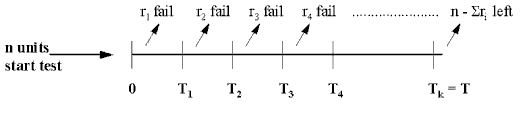
Sometimes exact times of failure are not known; only
an interval of time in which the failure occurred is recorded. This kind
of data is called Readout or Interval data and the situation
is shown in the figure below:

.

Multicensored Data

In the most
general case, every unit observed yields exactly one of the following three
types of information:

a run-time if the unit did not fail while under observation

an exact failure time

an interval of time during which the unit failed.

The units may all have different run-times and/or readout intervals.

Many special methods have been developed to
handle censored data

How do we handle censored data?

Many
statistical methods can be used to fit models and estimate failure rates, even with
censored data. In later sections we will discuss the
Kaplan-Meier approach,
Probability Plotting,
Hazard Plotting,
Graphical Estimation,
and Maximum Likelihood Estimation.

Separating out Failure Modes

Note that when a data set consists of failure times that can be sorted
into several different failure modes, it is possible (and often necessary)
to analyze and model each mode separately. Consider all failures due to
modes other than the one being analyzed as censoring times, with the censored
run-time equal to the time it failed due to the different (independent)
failure mode. This is discussed further in the competing
risk section and later analysis sections.